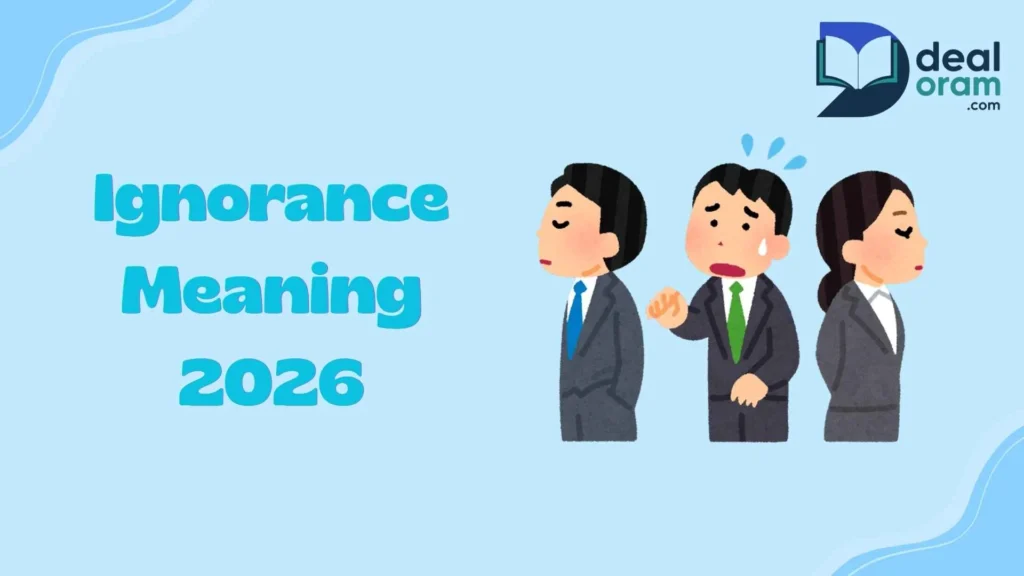
Ever been in a situation where someone said something totally wrong and then added, “Sorry, I didn’t know”? That moment perfectly captures the ignorance meaning in real life.
In today’s hyper-connected world 🌐, information is everywhere. Yet ignorance still shows up in conversations, social media debates, workplace misunderstandings, and even family chats. Knowing what ignorance really means and how to use the word correctly matters more than ever.
Many people confuse ignorance with stupidity, rudeness, or arrogance. But the truth is far more nuanced. Understanding this word can improve communication, reduce conflicts, and even make you more emotionally intelligent.
In this updated-for-2025 guide, you’ll learn the true definition of ignorance, its origin, real conversation examples, common mistakes, and how different generations use or interpret it today.
Let’s break it down 👇
What Does “Ignorance” Mean? (Definition + Origin)
Ignorance refers to a lack of knowledge, awareness, or information about something.
It does not necessarily mean someone is unintelligent they simply may not know.
Quick Answer:
Ignorance means not knowing or being unaware of something. It can be temporary and is usually fixed through learning or experience.
Origin of the Word
The term comes from the Latin word ignorantia, meaning “not knowing.” It entered English usage around the 13th century and has remained relevant across centuries from philosophical debates to modern internet discussions.
How Meaning Has Evolved
Historically, ignorance often implied moral or intellectual failure. Today, the meaning is more neutral. In modern communication, it can describe:
- Lack of exposure
- Misinformation
- Cultural misunderstanding
- Emotional unawareness
Pronunciation Guide
Ig-nuh-ruhnss
(/ˈɪɡ.nər.əns/)
How to Use “Ignorance” Correctly in Texts & Chat
This word carries emotional weight ⚖️. Using it correctly depends on tone and context.
Correct Context & Tone
Ignorance can sound:
- Neutral → “His ignorance about taxes is understandable.”
- Critical → “That comment showed pure ignorance.”
- Reflective → “I spoke out of ignorance.”
Platform-Specific Usage
- WhatsApp / SMS: Casual explanation or apology
- Instagram comments: Social awareness discussions
- Discord / Gaming chats: Strategy misunderstandings
- Reddit threads: Debate or opinion context
- X (Twitter): Often used in arguments or call-outs
When NOT to Use It
Avoid using “ignorance” in:
- Professional emails ✉️
- Formal presentations
- Performance reviews
- Sensitive emotional conflicts
It can sound accusatory.
Formatting Tips
- Usually lowercase
- Rarely abbreviated
- Often paired with emojis like 🤦♂️ or 😅 in casual chats
Example:
“Sorry, that was my ignorance 😅”
Real Conversation Examples Using “Ignorance”
Between Friends
A: “I thought Spain was in South America.”
B: “Bro… that’s ignorance 😂”
👉 Emotion: Playful correction without harsh judgment.
Dating Scenario
A: “I didn’t know that topic upset you.”
B: “It’s okay. Just ignorance, not intention.”
👉 Emotion: Forgiveness and understanding.
Family Chat
Mom: “Why don’t you just restart the Wi-Fi?”
Son: “That’s not how routers work… but it’s okay, just ignorance.”
👉 Emotion: Gentle explanation.
Workplace Slack Chat
Colleague: “I assumed you were free.”
You: “That assumption came from ignorance about my schedule.”
👉 Emotion: Boundary-setting without aggression.
Gaming Voice Chat 🎮
Player 1: “Rush the boss solo!”
Player 2: “That’s ignorance we need teamwork.”
👉 Emotion: Strategic correction.
Common Mistakes & Misunderstandings
1. Confusing Ignorance with Stupidity
Ignorance = lack of knowledge
Stupidity = difficulty learning
Huge difference.
2. Using It as an Insult
Calling someone “ignorant” in arguments can escalate conflict quickly 🔥.
3. Generational Misinterpretations
- Older generations may see it as disrespectful
- Gen Z may use it casually or humorously
4. Cultural Differences
In some cultures, labeling ignorance directly is seen as rude. Indirect phrasing works better.
Example alternative:
“Maybe there’s some misunderstanding here.”
“Ignorance” Across Different Platforms & Demographics
Gen Z Usage
- Used in social justice conversations
- Appears in TikTok debates and comment sections
- Often tied to awareness topics
Example: “Educate yourself that’s ignorance.”
Millennials
- More neutral tone
- Used in workplace learning or self-improvement context
Older Generations
- May interpret it as criticism
- Less common in casual speech
Formality Level
- Informal to semi-formal
- Generally not safe for strict professional settings
Related Slang, Abbreviations & Alternatives
| Term | Meaning |
|---|---|
| Unaware | Not conscious of facts |
| Clueless | Lacking understanding (casual) |
| Naive | Innocently inexperienced |
| Misinformed | Having incorrect info |
| Oblivious | Not noticing obvious things |
| Out of the loop | Missing updates |
| Sheltered | Limited exposure to reality |
| Blind spot | Missing awareness |
| Green | New or inexperienced |
| Dense (slang) | Slow to understand |
FAQs:
Is ignorance always negative?
Not always. Sometimes it simply reflects lack of exposure. Learning can remove ignorance quickly. In certain situations, not knowing stressful information may even protect mental peace.
What is “ignorance is bliss” meaning?
This phrase suggests that not knowing certain truths can make life feel happier or less stressful. It’s often used humorously or philosophically.
Can educated people be ignorant?
Yes. Education does not guarantee awareness in all areas. Someone may be highly knowledgeable in science but ignorant about social issues or technology trends.
How do you politely point out ignorance?
Use soft language like:
“Maybe there’s more to learn about this topic.”
This avoids sounding confrontational.
What are types of ignorance?
- Factual ignorance (missing knowledge)
- Cultural ignorance (lack of exposure)
- Willful ignorance (choosing not to know)
- Emotional ignorance (low empathy)
Conclusion:
Understanding the ignorance meaning helps you communicate smarter not harsher. It reminds us that not knowing is human. Staying ignorant by choice? That’s different.
The next time you hear something incorrect, pause before judging. It might simply be a gap in knowledge, not a flaw in intelligence.
And if you catch yourself speaking from ignorance good news. That’s the first step toward growth 🚀.
Want to expand your digital vocabulary?
👉 Explore more slang guides and drop your favorite abbreviation in the comments!

Hi, I’m John James, the writer behind Dealoram.com, where meanings aren’t just explained… they’re decoded for real life.
I started this platform with one goal: make words easier to understand in a world where language keeps evolving every day. From trending slang to deeper word meanings, I break things down in a way that’s simple, clear, and actually useful.
No complicated definitions. No wasted time. Just straight answers that help you understand what people really mean, and how to use it yourself.